

New Publication by FELMI-ZFE on EDXS simulations
We are happy to share the link to the recent publication in Ultramicroscopy of our FELMI-ZFE scientists.
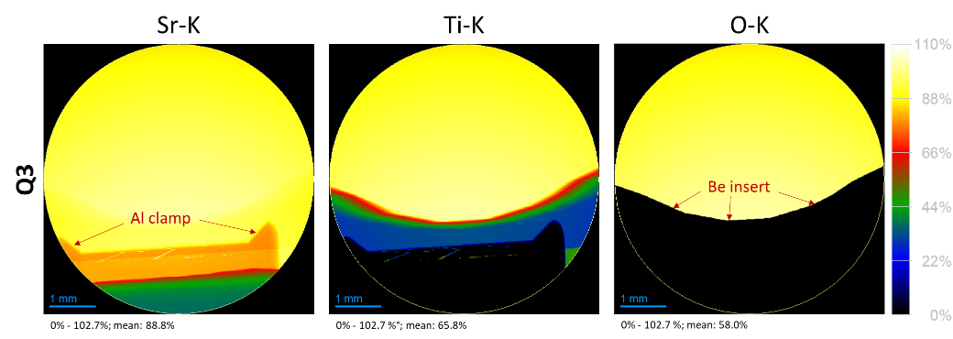
The geometric configuration of an EDX system in a TEM with multiple detectors and different sample holders is complex and cannot be described analytically. To calculate detector shadowing, “ray tracing” must be used to determine, for each X-ray photon, whether it can penetrate any obstacles along its path (e.g. sample holder). This procedure can be performed using our edXTrace program, which outputs a “correction file” that corrects the intensities of the shadowed EDX spectrum. Only then does the quantitative analysis yield the correct results. This paper makes a significant contribution to the field of quantifying EDX spectra using modern detector systems.
edXTrace: A ray tracing software tool for correcting absorption effects and detector shadowing for EDXS quantification in the TEM
Nikolaus Grogger, Michael Oberaigner, Judith Lammer, Johanna Kraxner, Daniel Knez, Georg Haberfehlner, Gerald Kothleitner, Werner Grogger
https://doi.org/10.1016/j.ultramic.2026.114427
The geometric configuration of an EDX system in a TEM with multiple detectors and different sample holders is complex and cannot be described analytically. To calculate shadowing, “ray tracing” must be used to determine, for each X-ray photon, whether it can penetrate any obstacles along its path or what the probability is that it will be absorbed by parts of the sample holder. If this process is performed for all X-ray quanta that could potentially strike the detector screens, an image of the shadowing is obtained for each individual detector. Since this shadowing depends on the energy of the X-ray quantum, the shadowed areas on the detectors look different for each X-ray energy.
This ray-tracing procedure can be performed using our edXTrace program. The program is extremely flexible in terms of the shape and arrangement of the detectors. One of the possible outputs is a “correction file” that corrects the intensities of the shadowed EDX spectrum. Only then does the quantitative analysis yield the correct results. In our paper, we use examples to demonstrate how well this works and what it looks like when the shadows are caused, for example, by the FIB mesh to which the TEM lamella is attached. In addition, given the sample geometry and composition, edXTrace can calculate the absorption of X-rays before they exit the sample. edXTrace is available on the FELMI-ZFE’s GitLab account at TU.
As a FELMI-ZFE project, this paper makes a significant contribution to the field of quantifying EDX spectra using modern detector systems.