In materials science, innovation often lies in imperfection. Tiny atomic defects, a missing atom, an extra one, or a single substitution, can determine how a material conducts electricity, catalyzes reactions like green hydrogen production, or stores energy in a battery.
Yet reliably detecting individual defects, and the subtle charge redistributions around them, remains one of the hardest problems in electron microscopy because these signals are extremely small and the materials often beam-sensitive.
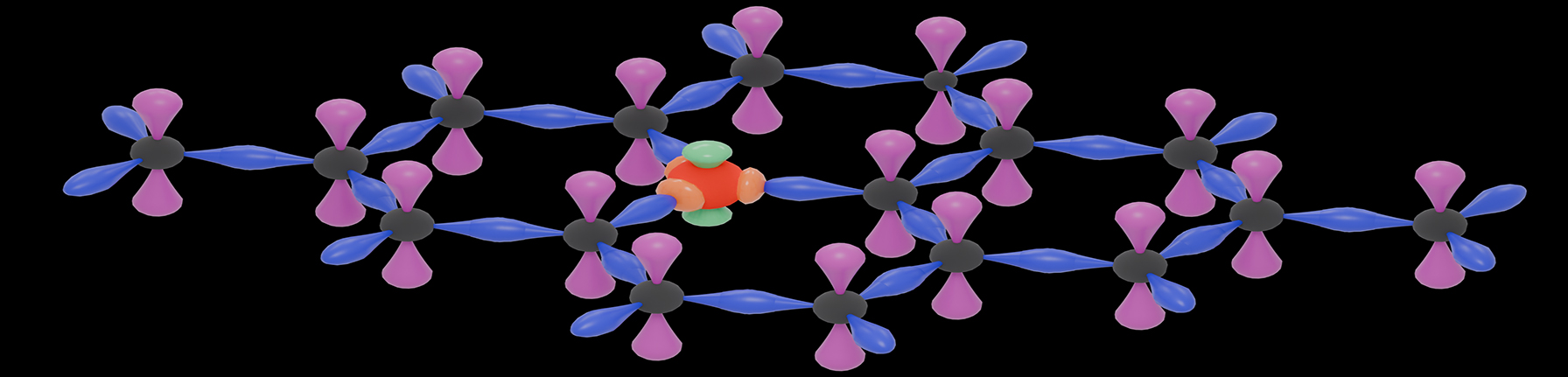
This project tackles the problem by rethinking scanning transmission electron microscopy: instead of recording only a conventional image, we will capture the full electron-scattering response at every point, creating a rich dataset that cannot be interpreted directly. We will develop advanced ptychographic electron phase reconstruction methods that convert these measurements into precise maps of atomic positions and local charge changes around defects.
To make the reconstructions robust, we will integrate realistic simulations and modern machine learning, using physics-based constraints to suppress noise, drift, and misleading artifacts. Higher sensitivity will also let us work at very low electron dose, so we can observe defects without destroying them.
By validating the approach on well-controlled systems such as graphene and molybdenum disulphide, we will release an open-source toolset for the community, enabling more reliable defect mapping and ultimately supporting the design of better electronics and sustainable energy technologies.
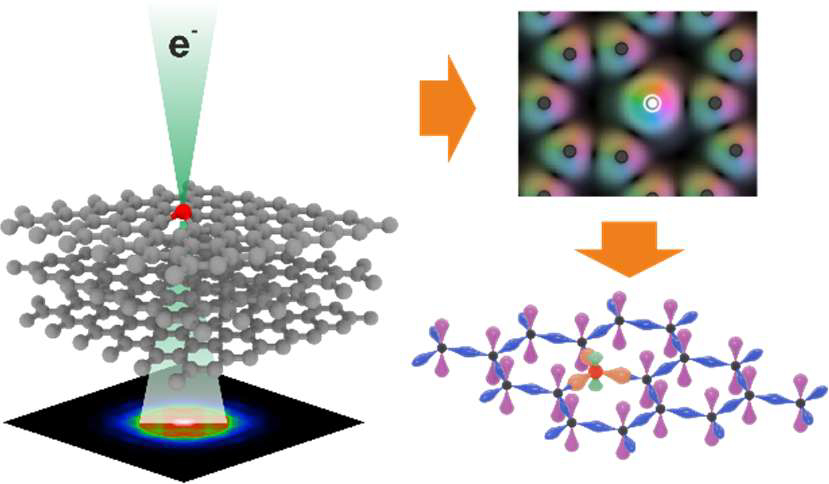
Figure of the AtomDensityMap workflow: Defect-engineered vdW materials are synthesized and measured by momentum-resolved STEM (4D-STEM). The resulting diffraction data is inverted via ptychographic phase reconstruction that is guided by physics-based simulations (structure/charge priors), forming an iterative experiment-theory loop that yields robust atomic and charge-density maps for single–point-defect characterization.
The AtomDensityMap project is funded by the Austrian Science Fund (FWF, no. 10.55776/PIN1180625 ).
Kooperationspartner
National:
Montanuniversität Leoben, Chair of Physics, Matkovic’s Lab
International:
Fritz-Haber-Institute of the Max-Planck-Gesellschaft, Theory Department, Berlin (Germany)
FZ Jülich, Ernst Ruska-Centre for Microscopy and Spectroscopy with Electrons, Jülich (Germany)