


The European Research Council has awarded Robert Winkler an ERC Starting Grant that will start on 1 January 2026 and run for five years at FELMI-ZFE. The ERC project PRINTBOT aims to establish a new generation of 3D-printed microbots that can operate in complex fluid environments.
The project builds on 3D-nanoprinting with focused particle beams, a technology developed at Graz University of Technology that can “write” complex three-dimensional architectures with feature sizes down to a few tens of nanometers. By extending this technology towards multi-material printing, PRINTBOT aims to fabricate microbots smaller than 10 µm that combine efficient propulsion with integrated functional tools.
Two main propulsion concepts are pursued: magnetic helical swimmers and microbots driven by artificial cilia – hair-like structures inspired by biology. Both are actuated by weak external magnetic fields, enabling controlled motion in viscous liquids. On-board functions include size-selective particle capture and release, as well as plasmonic nano-antennas that can generate local heating when illuminated, for example to damage tumor tissue or inactivate pathogens. As a visionary demonstrator, PRINTBOT will prototype an “ImmunoBot”: a microbot capable of collecting harmful particles such as viruses and neutralizing them on demand.
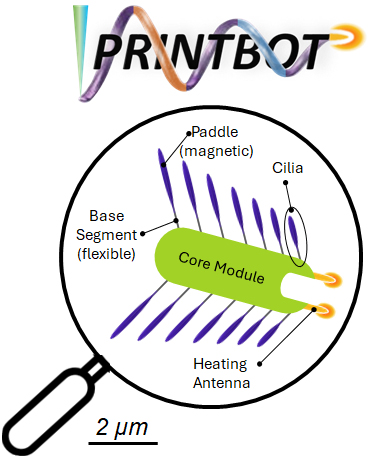
Fig. Schematic illustration of a microbot concept fabricated by multi-material 3D nanoprinting. The microbot is actuated by an external magnetic field and integrates plasmonic antennas for localized heating.